Following egg retrieval and fertilisation, one of the most common questions couples ask is why the number of embryos decreases as the days of laboratory culture progress.
An egg may be mature, fertilise normally and begin its first cell divisions without ultimately reaching the blastocyst stage. This does not necessarily mean that an error occurred or that the IVF process failed.
Fertilisation marks the beginning of a highly complex developmental journey. For a blastocyst to form, the embryo must successfully complete a series of cellular, genetic and metabolic processes. When one of these mechanisms does not function properly, development may slow down or stop.
The gradual reduction in the number of embryos is, to a large extent, part of the natural biological selection that occurs during preimplantation development. Science cannot yet predict with absolute accuracy which early-stage embryo will develop into a viable blastocyst.
What is a blastocyst?
A blastocyst is an advanced stage of embryo development, usually reached on the fifth or sixth day after fertilisation.
At this stage, the embryo is no longer simply a group of similar cells. It has begun to develop an organised structure that includes:
the inner cell mass, from which the embryo may develop,
the trophectoderm, which will mainly contribute to the formation of the placenta,
the blastocoel, the fluid-filled cavity inside the blastocyst.
The formation of these distinct cell populations requires appropriate cell division, communication between cells, activation of specific genes and sufficient energy production. The blastocyst is the developmental stage that precedes implantation in the endometrium.
What are the stages from fertilisation to blastocyst?
After the egg and sperm unite, the fertilised egg begins to divide.
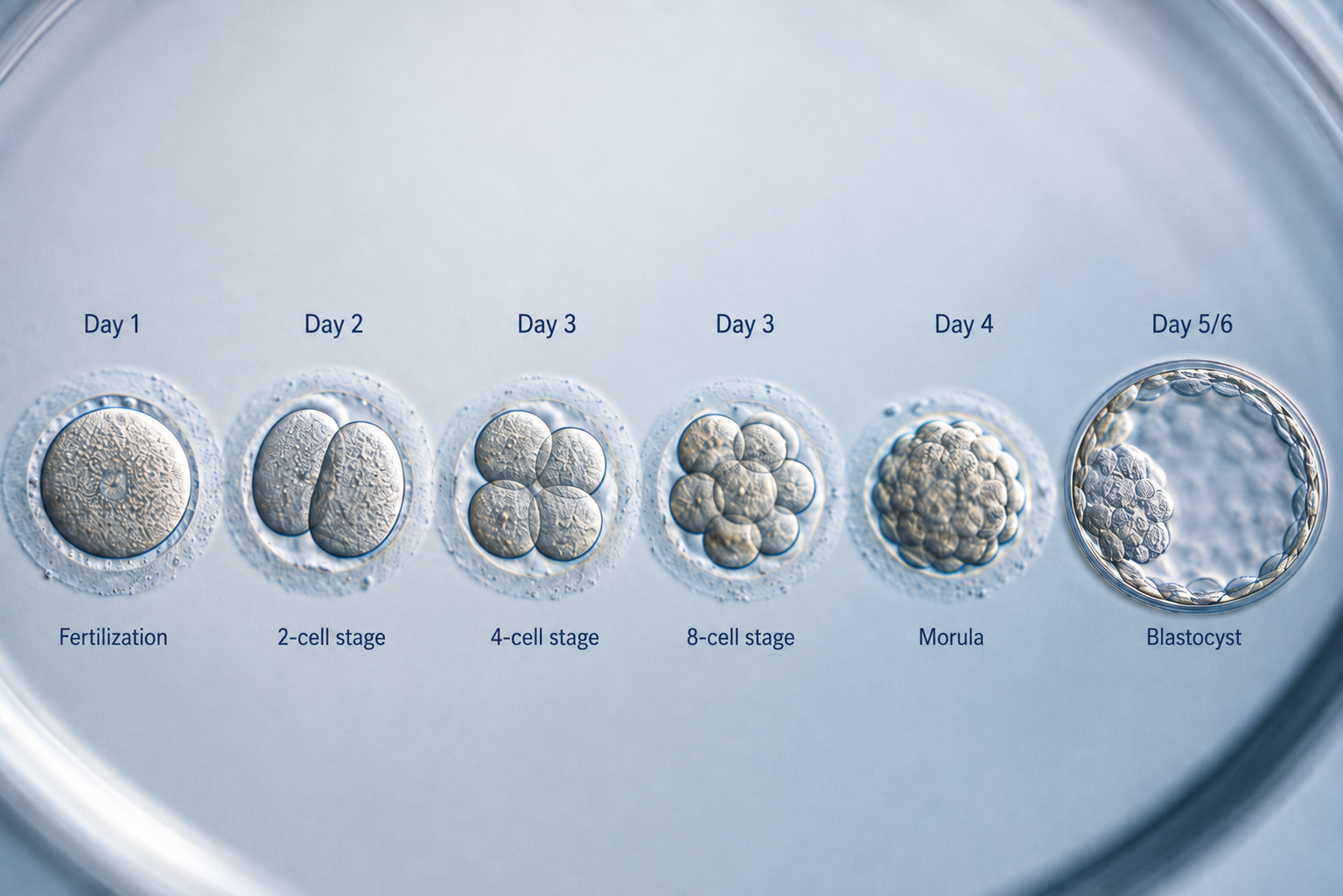
During the first days of culture, the following stages are observed:
Normal fertilisation.
This is usually confirmed by the presence of two pronuclei, one maternal and one paternal.The first cell divisions.
The embryo divides into two, four and then a larger number of cells.Compaction.
Around the fourth day, the cells come into closer contact and form the morula.Blastocyst formation.
On the fifth or sixth day, the blastocyst cavity forms and its cells begin to differentiate.
Each of these stages acts as a new biological checkpoint. An embryo may begin developing normally but may not have the necessary biological capacity to complete the next developmental step.
Why does normal fertilisation not guarantee blastocyst formation?
Confirmation of fertilisation shows that the egg and sperm have successfully united. However, it does not confirm that the embryo has the correct number and structure of chromosomes or that all the mechanisms required for its subsequent development will function properly.
Over the following days, the embryo must accurately copy and distribute its genetic material to each new cell. At the same time, it must activate its own genome and take control of its development.
Disruptions at any of these stages may lead to slower or abnormal development and, in some cases, complete developmental arrest.
What is the role of chromosomal abnormalities?
Chromosomal abnormalities are among the most important biological causes of developmental arrest.
A normal human embryo should contain the correct number of chromosomes. When chromosomes are missing or present in excess, the embryo is described as aneuploid. Many embryos with significant chromosomal abnormalities are unable to complete preimplantation development and stop developing before reaching the blastocyst stage.
Chromosomal abnormalities may arise during the maturation of the egg or sperm, as well as during the embryo’s first cell divisions.
Their likelihood increases significantly with female age, mainly because of changes in the mechanisms responsible for separating chromosomes within the egg. This is one of the main reasons why, as age increases, a greater number of mature eggs may be required to obtain at least one chromosomally normal blastocyst.
How does egg quality affect development?
The egg does not provide only half of the embryo’s genetic material. During the first days after fertilisation, it also provides the cellular components, energy reserves and molecular mechanisms required for the initial cell divisions.
The developmental potential of an egg is influenced by factors such as:
the woman’s age,
the appropriate maturation of the egg,
its ability to produce the energy required for development,
the correct distribution of chromosomes,
the environment in which the follicle developed.
An egg may appear mature during laboratory assessment but still have biological or genetic limitations that cannot be seen under the microscope. For this reason, its external appearance cannot fully reflect its actual developmental potential.
Can the sperm also affect embryo development?
Yes. The sperm contributes the paternal genetic material and is involved in important mechanisms during the first cell divisions.
Factors such as severe abnormalities in the semen analysis or damage to sperm DNA have been studied in relation to embryo quality and development.
However, this relationship is complex, and the available scientific evidence does not always lead to the same conclusions. The effect of the male factor may vary depending on the characteristics of the sperm, the fertilisation method and the overall quality of the eggs.
A low blastocyst formation rate should therefore not automatically be attributed exclusively to the eggs or exclusively to the sperm. All the data from the treatment cycle need to be assessed together.
What does embryo developmental arrest mean?
Developmental arrest describes a situation in which an embryo stops dividing and shows no meaningful progression over a specific period.
Developmental arrest may occur at different stages:
immediately after fertilisation,
during the first cell divisions,
during activation of the embryonic genome,
at the morula stage,
shortly before or during blastocyst formation.
There is no single mechanism that explains every case. Current research associates developmental arrest with chromosomal or genetic abnormalities, problems with energy production, metabolic disorders and dysfunctions during cell division.
Can an embryo that looks good on day three fail to become a blastocyst?
Yes. The assessment of an embryo on the third day is based mainly on its appearance and the rate of its development. Embryologists examine whether cell divisions are progressing smoothly and whether the embryo’s overall morphology is consistent with the expected developmental stage.
These observations provide valuable information, but they represent only a snapshot of the embryo at a particular point in time. They cannot reveal with certainty its chromosomal composition or all the biological mechanisms that will determine its subsequent development.
An embryo with a good appearance on day three may stop developing before reaching the blastocyst stage. Similarly, an embryo with less favourable characteristics may, in some cases, continue to develop.
Despite advances in laboratory assessment methods, there is currently no way to predict with absolute certainty which embryo will develop into a viable blastocyst.
Are day-six blastocysts less important?
Not necessarily. Some embryos reach the blastocyst stage on the fifth day, while others require more time and develop on the sixth or, more rarely, the seventh day.
The rate of development is one of the parameters considered by the embryologist. At a population level, day-five blastocysts often show better average outcomes than blastocysts that develop later. However, this does not mean that a day-six blastocyst cannot be suitable for cryopreservation, genetic testing or embryo transfer.
The final assessment is based on how smoothly and promptly the blastocyst developed, as well as on its overall morphological appearance. When preimplantation genetic testing has been performed, the genetic result is also taken into consideration.
How many fertilised eggs are expected to become blastocysts?
There is no single percentage that applies to every woman or every IVF treatment cycle.
The probability of blastocyst formation is influenced by:
the woman’s age,
the number and maturity of the eggs,
the characteristics of the sperm,
the fertilisation method,
the quality and rate of embryo development,
the individual reproductive history,
the conditions and experience of the embryology laboratory.
Even in the same woman, two different treatment cycles may produce different results. For this reason, general percentages found online cannot accurately predict the outcome of an individual cycle.
The ability to produce blastocysts varies considerably between patients, and there are currently no reliable criteria that can predict the outcome of every embryo with certainty.
What is the role of the embryology laboratory?
Preimplantation development takes place within a particularly sensitive environment. The organisation and operational quality of the embryology laboratory are therefore highly important.
The parameters that must be strictly controlled include:
temperature,
the conditions of the culture media,
oxygen and carbon dioxide concentrations,
air quality,
incubator stability,
the appropriate handling of embryos,
the training and experience of the embryologists,
the implementation of quality-control systems.
Current guidelines define specific requirements for embryo culture, monitoring, safety and traceability within IVF laboratories.
High-quality laboratory procedures can support the best possible embryo development. However, they cannot correct every genetic or biological problem already present in the egg, sperm or embryo.
Does a low blastocyst formation rate mean that a laboratory error occurred?
An unexpectedly low number of blastocysts requires careful review, but it does not, on its own, prove that a laboratory problem occurred.
To assess the result correctly, the entire course of the treatment cycle should be examined:
how many eggs were retrieved,
how many were mature,
how many fertilised normally,
how they developed during the first days,
at which stage their development stopped,
the available sperm data,
the woman’s age and medical history,
whether a similar pattern has occurred during previous cycles.
The outcome of a single attempt may also be affected by natural biological variation. However, when a low blastocyst formation rate occurs repeatedly, more targeted investigation and a comprehensive reassessment of the treatment strategy are required.
Can the number of blastocysts be increased?
There is no single treatment or technique that can guarantee that a greater number of fertilised eggs will reach the blastocyst stage.
The clinical and laboratory team may review:
the selection and dosage of the ovarian stimulation protocol,
the timing of the final maturation injection,
the proportion of mature eggs,
the fertilisation method,
the available male-factor data,
the rate and overall pattern of embryo development,
the culture conditions,
the results of previous treatment cycles.
An individualised approach may improve the overall strategy and reduce factors that can be modified. However, it cannot overcome the natural biological and genetic limitations of each embryo.
Does a cycle without a blastocyst mean that the same thing will happen again?
No. The result of one cycle provides important information, but it is not an absolute prediction of all future attempts.
The number and quality of eggs may differ from one cycle to another. The same applies to sperm characteristics, fertilisation and the pattern of embryo development.
Even after a cycle in which no suitable blastocyst was obtained, or only chromosomally abnormal embryos were identified, a subsequent cycle may have a different outcome. Age remains an important prognostic factor, but no single cycle can completely define all future possibilities.
The individualised approach at Ovagenesis
At Ovagenesis, the assessment is not limited to the final number of blastocysts.
Every stage of the process is examined in detail: ovarian response, egg maturity, fertilisation, the course of embryo development, the stage at which development may have stopped and the available male-factor data.
A comprehensive review of the cycle helps distinguish, as far as this is scientifically possible, between factors that can be modified and those that reflect the natural biology of the gametes and embryos.
The objective is to develop an individualised plan for the next attempt, based on scientific evidence, clear communication and realistic expectations.
A detailed assessment of the entire treatment cycle can provide meaningful information and help determine the most appropriate next steps.