A low AMH level can understandably cause concern for a woman who wishes to have a child. It is often interpreted as an indication that “the eggs are running out” or even that pregnancy is no longer possible.
The reality, however, is more complex.
AMH is a useful marker of ovarian reserve, but it is not a standalone “fertility test.” It cannot accurately predict whether a woman will conceive naturally, nor is it sufficient on its own to assess egg quality or the likelihood of having a baby. Its correct interpretation requires consideration of age, individual medical history, ultrasound findings and, when previous treatment has taken place, the ovaries’ actual response.
What is AMH?
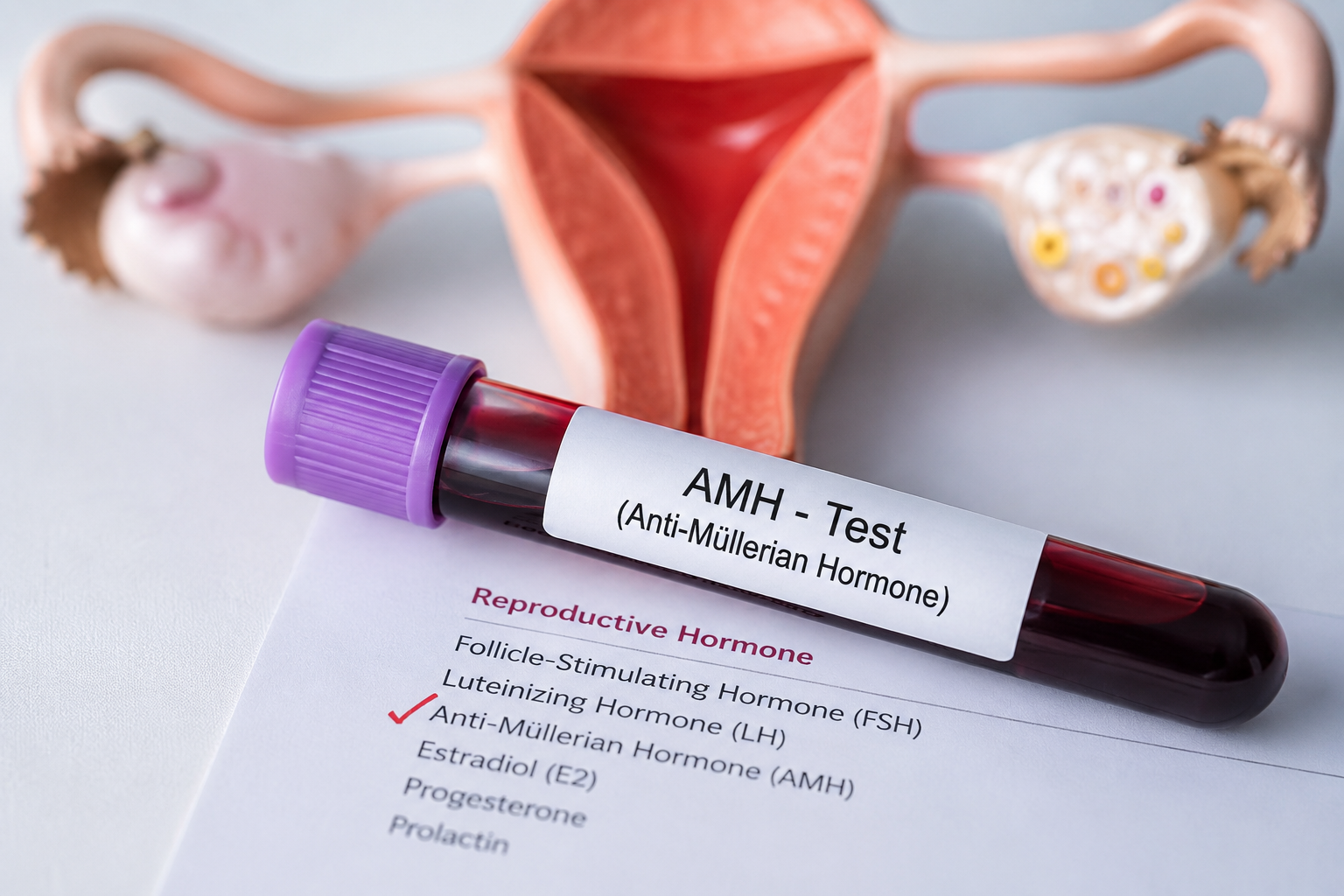
Anti-Müllerian hormone, commonly known as AMH, is produced by the granulosa cells of small, developing follicles in the ovaries.
Its concentration in the blood is used as an indirect indication of the number of follicles that remain available in the ovaries. For this reason, AMH is primarily associated with the quantity of the ovarian reserve rather than egg quality.
Compared with other hormones, AMH levels tend to fluctuate less throughout the menstrual cycle. Therefore, the test can usually be performed regardless of the day of the cycle, although every result should be evaluated within the overall clinical context.
AMH mainly provides information about the expected number of eggs and the potential response of the ovaries to stimulation. On its own, it does not determine whether a woman can become pregnant.
What does low AMH mean?
A low AMH level may indicate that ovarian reserve is lower than expected. This means that the ovaries may contain a smaller number of developing follicles and that fewer eggs may be produced during ovarian stimulation.
However, there is no single absolute value that has exactly the same meaning for every woman.
The interpretation depends on:
the woman’s age,
the testing method and the laboratory’s reference ranges,
the antral follicle count observed on ultrasound,
the use of hormonal contraception,
the woman’s gynaecological and surgical history,
the ovaries’ previous response to stimulation.
A level considered low for a 28-year-old woman does not necessarily have the same clinical significance as the same level in a 40-year-old woman. The result should primarily be compared with the expected values for the relevant age group rather than with a single general threshold.
Low AMH and Egg Quality: Are they the same?
No. Egg quantity and egg quality are two different parameters.
AMH is more closely associated with the expected number of eggs that may develop, particularly during ovarian stimulation. It does not directly assess the chromosomal or developmental competence of each egg.
Age remains one of the most important factors associated with egg quality and the probability of achieving pregnancy. A younger woman with low AMH may have fewer eggs, but those eggs may still be of good quality. Similarly, a normal or high AMH level at a more advanced reproductive age does not eliminate the effects of age on egg quality.
Low AMH should therefore not automatically be interpreted as “poor egg quality.”
Does Low AMH mean that natural conception is not possible?
Low AMH does not mean that natural conception is impossible.
Studies have shown that ovarian reserve markers cannot accurately predict the probability of natural pregnancy during each menstrual cycle. Women with low AMH may continue to ovulate normally, have regular menstrual cycles and achieve natural conception.
This does not, however, mean that a low result should be ignored. It may indicate a shorter reproductive timeframe, particularly when combined with older age, a reduced antral follicle count or a previous low response to treatment.
The probability of natural conception also depends on several other factors, including:
whether ovulation occurs normally,
whether the fallopian tubes are open,
the condition of the uterus and endometrium,
sperm quality,
the age of both partners,
the length of time the couple has been trying to conceive.
AMH is therefore one part of the overall assessment, not the final answer.
Which factors may be associated with low AMH?
The most common cause of declining AMH is natural reproductive ageing. As age increases, the number of available ovarian follicles gradually decreases.
Lower levels may also be observed in women with:
an individual or family predisposition to an early decline in ovarian function,
a history of ovarian surgery,
endometriomas or endometriosis,
previous chemotherapy or radiotherapy,
a history of smoking,
certain genetic or autoimmune conditions.
Surgical treatment of an endometrioma, particularly when both ovaries are involved, may in some cases be associated with a reduction in measured AMH levels. Decisions regarding surgery should therefore be individualised and should also take future reproductive plans into consideration.
At the same time, long-term use of hormonal contraception may temporarily reduce ovarian reserve markers in some women. In selected cases, a doctor may recommend repeating the test after contraception has been discontinued. This does not mean that any medication should be stopped without medical guidance.
Is low AMH the same as premature ovarian insufficiency?
No. Diminished ovarian reserve and premature ovarian insufficiency are not the same condition. A woman may have low AMH while continuing to have regular menstrual periods and normal ovulation.
The diagnosis of premature ovarian insufficiency is primarily based on a history of menstrual irregularity and FSH levels, considered together with the overall clinical profile. Current guidelines do not recommend AMH as the main or sole test for diagnosing this condition.
A very low AMH level should therefore not lead to self-diagnosis or definitive conclusions without a complete hormonal and ultrasound assessment.
How should a low AMH level be evaluated?
The assessment begins with a detailed medical and reproductive history. The doctor considers the woman’s age, the duration and regularity of her menstrual cycle, previous pregnancies, surgical procedures, fertility treatments and possible risk factors.
Depending on the individual case, the following may also be considered:
Transvaginal ultrasound and antral follicle count — AFC.
This provides an ultrasound assessment of the number of small follicles visible in the ovaries.FSH and oestradiol.
These hormones are usually measured at the beginning of the menstrual cycle and may provide complementary information, particularly when AMH is very low.Previous ovarian response.
When a woman has previously undergone IVF, the number of follicles that developed and the number of eggs retrieved provide particularly important clinical information.A complete fertility assessment of both partners.
The evaluation should not be limited to AMH. Where appropriate, it may also include assessment of the fallopian tubes, uterus, ovulation and male fertility factors.
AMH and AFC are considered reliable markers for predicting a low or high ovarian response to stimulation. However, they do not predict pregnancy or live birth with the same level of accuracy.
What does low AMH mean in IVF?
In IVF treatment, AMH helps the doctor estimate how strongly the ovaries may respond to medication used for ovarian stimulation.
A low AMH level may be associated with:
the development of fewer follicles,
the retrieval of fewer eggs,
the possibility that more than one treatment cycle may be required to obtain a sufficient number of eggs or embryos,
the need to adapt the stimulation protocol to the individual characteristics of the woman.
It does not, however, mean that the chance of success is zero. Even very low AMH levels should not be used as the sole reason to exclude a woman from IVF treatment.
Excessively increasing the medication dosage does not improve egg quality or increase the probability of success indefinitely. The aim is not simply to administer the highest possible dose, but to select a safe and individualised treatment protocol.
When is immediate investigation recommended?
Medical assessment should not be delayed when there is:
low AMH combined with an age over 35,
an irregular menstrual cycle or absence of menstruation,
a history of ovarian surgery,
endometriosis or an endometrioma,
a family history of early menopause,
previous chemotherapy or radiotherapy,
a previous low response to IVF,
unsuccessful attempts to conceive.
In general, a fertility assessment is recommended after 12 months of regular unprotected intercourse for women under the age of 35 and after six months for women over 35. After the age of 40, or when known risk factors are present, evaluation should begin without delay.
The individualised approach at Ovagenesis
At Ovagenesis, low AMH is not treated as an isolated laboratory value.
The evaluation is based on a combination of age, ultrasound findings, hormonal profile, medical history and the woman’s previous reproductive journey. The objective is to identify the actual possibilities in each individual case and to develop a personalised plan based on scientific accuracy and realistic expectations.
Early and comprehensive investigation can support informed decision-making, without premature conclusions and without unnecessary delays.
Conclusion
Low AMH is important information, not a definitive prognosis.
It mainly indicates that the available ovarian reserve may be limited and that the response to ovarian stimulation may be lower. On its own, it does not prove that a woman cannot conceive, nor does it accurately describe the quality of all her eggs.
The essential question is not simply “How low is the AMH?” but what that specific result means for the individual woman, at her particular age and stage of her reproductive journey.
A comprehensive fertility assessment can provide a clearer understanding of the situation and help determine the most appropriate next steps.